How Does a Robot Lawn Mower Work? Sensors, Wires and Docking
- Sits under
- Gardening, Technology
- Posted
- Read time, roughly
- 4 min
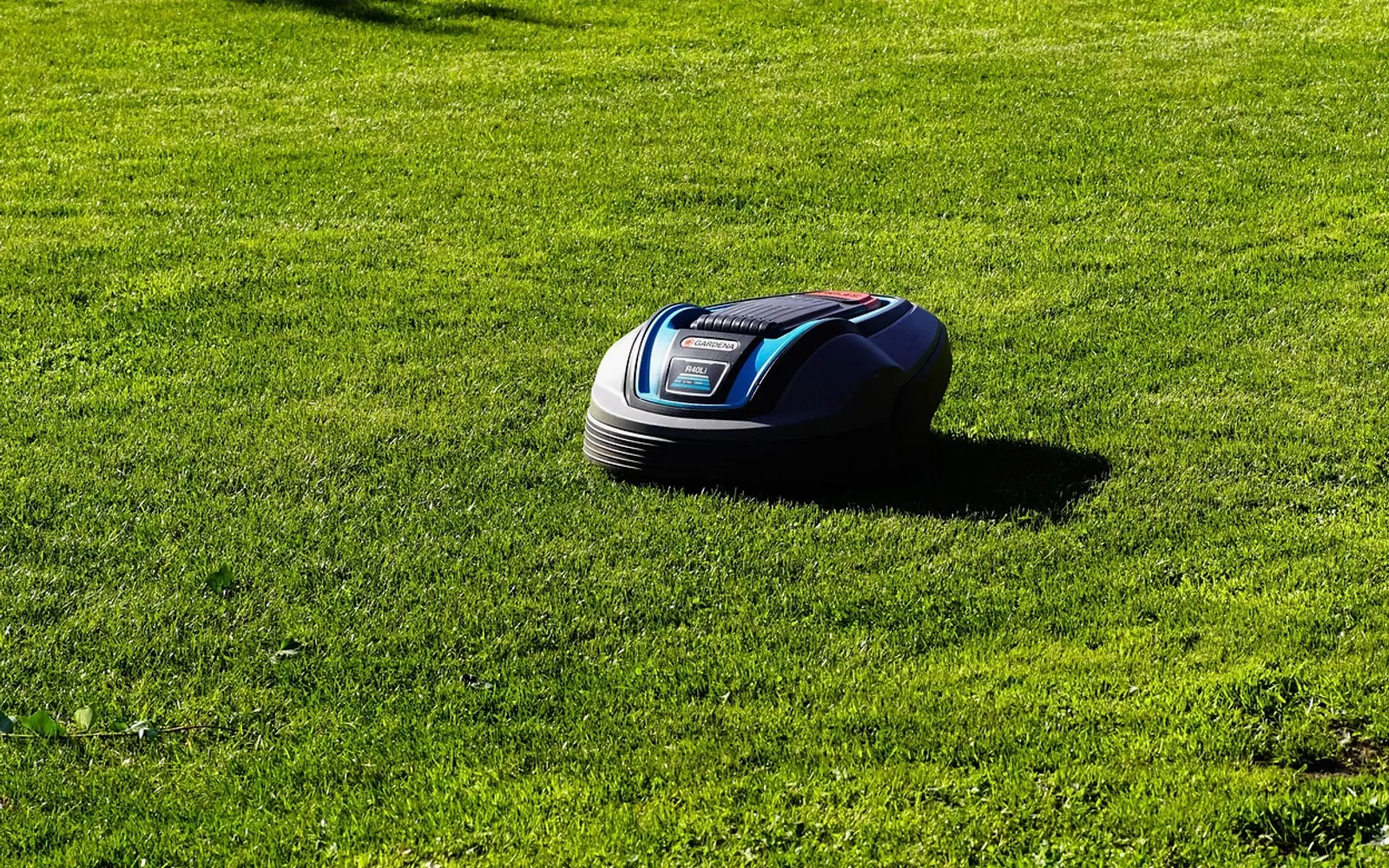
A robot lawn mower is a small battery-powered machine that cuts grass on its own, a little at a time, inside a boundary you set up once. Most models know where the lawn ends through a thin boundary wire pegged around the edge, while newer wire-free models use satellite positioning with a reference station, or cameras. Sensors stop the blades when the mower is lifted or tipped, and when the battery runs low it drives back to its charging dock, recharges and carries on.
The main parts
- Cutting disc: usually a spinning disc with small pivoting razor-style blades, or a single bar blade, set low in the body.
- Drive wheels and motors: independent motors for steering and turning on the spot.
- Battery: a rechargeable lithium-ion pack that runs for a set time before docking.
- Charging station: the dock the mower returns to, which also acts as its home base.
- Sensors: lift, tilt and bump sensors on almost all models, with rain sensors, ultrasonic or camera obstacle detection on some.
- Controls: a keypad, a phone app or both, for schedules, cutting height and security settings.
How the mower knows where to go
The boundary system is the biggest difference between models.
| Boundary type | How it works | Good for |
|---|---|---|
| Perimeter wire | A low-voltage signal runs through a wire laid around the lawn edge and around flower beds; the mower turns when it detects it | Most gardens, especially those with trees and buildings that block the sky |
| Satellite positioning with a base station | A reference station corrects satellite signals so the mower knows its position precisely; boundaries are drawn in an app | Open lawns with a clear view of the sky, and owners who change layouts often |
| Camera or vision | The mower recognises grass edges and obstacles from images | Simple, well-defined lawns; performance varies with light and grass condition |
Wired systems also use a guide wire on many models, a second wire running from the dock across the lawn that helps the mower find its way home through narrow passages.
Little and often: the cutting method
A robot mower does not collect clippings. It cuts only the tips of the grass, several times a week, so the fine pieces fall back into the turf and break down. This mulching approach returns nutrients to the soil and keeps the lawn at an even height. Some models drive in random patterns, crossing the lawn at changing angles until every area is covered over time; others plan straight parallel lines, which leaves visible stripes and can finish sooner.
Docking and charging
When the battery drops to a set level, the mower follows the boundary wire, the guide wire or its positioning map back to the dock. Contacts on the dock line up with plates on the mower, charging begins, and the schedule resumes once the battery is full. Many owners plan mowing windows so the machine works during the day and rests overnight.
Safety features
Blades stop within moments if the mower is lifted or tilted beyond a set angle, and bump sensors make it reverse and turn when it hits something. Most models also have a PIN code and an alarm, and some can be tracked through the app. None of this replaces sensible supervision: keep children and pets away while the mower runs, clear toys and garden hoses off the grass, and avoid night-time mowing, when small wildlife such as hedgehogs is most active.
Where robot mowers struggle
- Steep slopes: each model has a maximum gradient, and wet grass reduces grip.
- Narrow passages: tight gaps between beds confuse some boundary set-ups.
- Edges: the cutting disc sits inside the body, so a strip along walls, paths and the edge of an asphalt driveway may need occasional trimming.
- Long or rough grass: robots maintain lawns well but are not built to tame a meadow; cut it down first.
- Cables and lights: exposed wiring for garden lighting can be damaged, so bury it or keep it outside the mowing area.
Fitting it into the rest of the garden
Garden technology works best when it is planned together. If you have spotlights placed around trees and paths, mark their stakes and cables before laying the boundary wire. Small fixtures such as solar path lights are easy for a mower to bump, and a mower that keeps hitting them can dirty their panels; the checklist for solar lights that stop working covers what to do if they dim afterwards.
Quick answers
Does a robot lawn mower need a boundary wire?
Many do. Wire-free models exist that use satellite positioning or cameras, but they need suitable conditions, such as a clear view of the sky.
Can a robot mower work in the rain?
Most are built to handle rain, though some pause automatically with a rain sensor. Cutting wet grass can leave a less tidy finish and may affect grip on slopes.
How long does installation take?
It depends on the lawn size and boundary type. Wired systems take longer because the wire must be pegged or buried around every edge and bed.
Fresh in every section
Good places to start
 InsurancePet Insurance Waiting Periods: How They Work Before Cover Starts4 min
 GardeningWhy Are My Solar Lights Not Working? Simple Checks and Fixes4 min
 Real estateImpact of Singapore’s Real Estate Boom on Local Communities2 min
 Social MediaThe Cost of Ignoring SEO: What Montreal Businesses Risk Losing2 min
Questions? Write to us.
Suggestions help us plan.